
Why Kareri Lake Trek is on every trekker's list
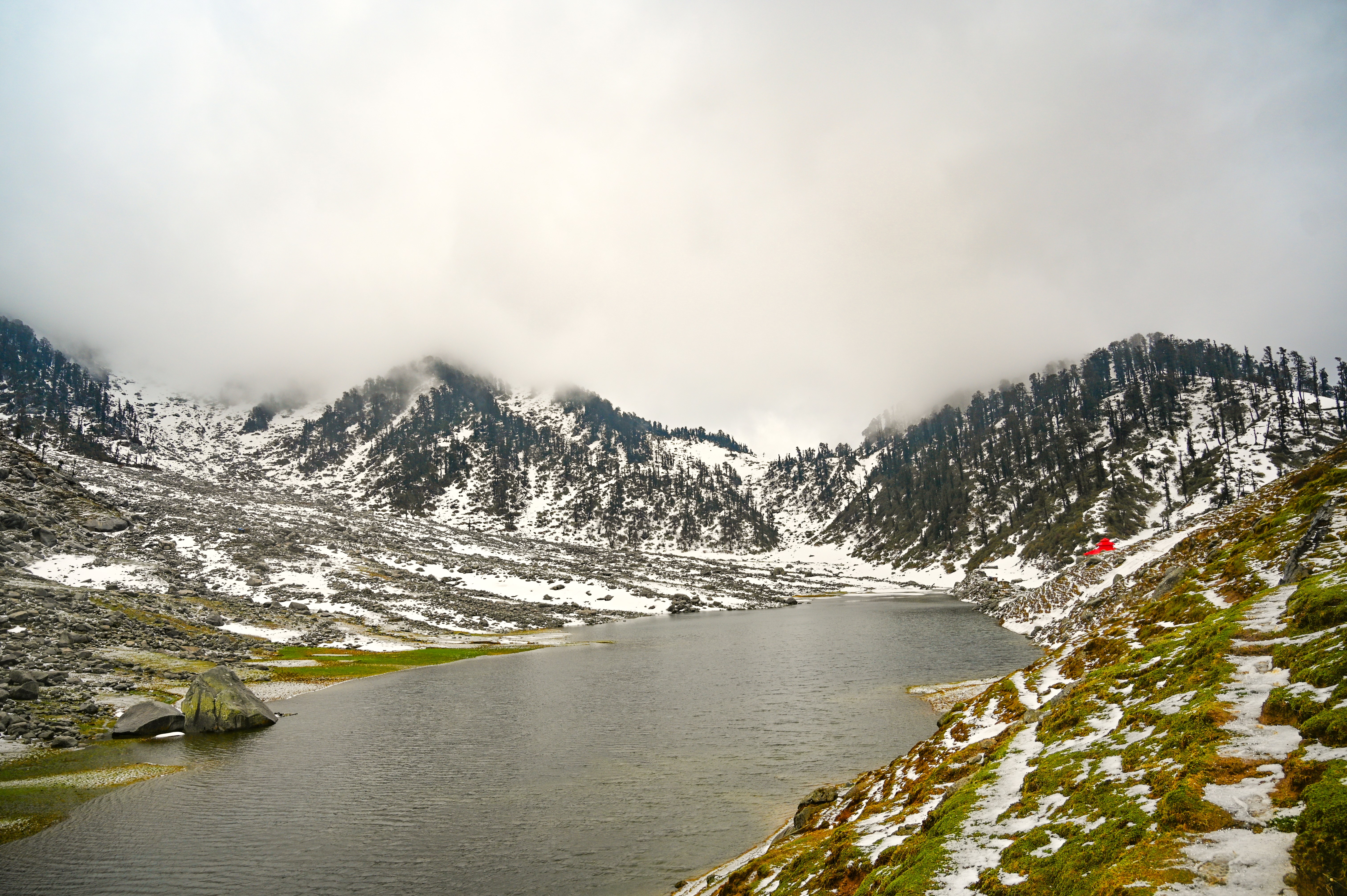
Tucked into the folds of the Dhauladhar Range in Himachal Pradesh, Kareri Lake sits at a crisp 2,934 metres (9,626 ft) above sea level — a glacial freshwater jewel that rewards every step of the approach. Unlike the perpetually packed Triund Trek, Kareri offers genuine solitude: pine-scented forests, boulder-strewn stream crossings, open meadows carpeted with wildflowers, and those jaw-dropping Dhauladhar ridgelines that make you stop mid-stride just to stare.
What makes this trek particularly special in 2026 is its sweet spot: still under the mainstream radar, yet accessible enough for first-time trekkers flying into Dharamsala. Whether you have two days or four, this guide covers every detail — route, itinerary, permits, costs, packing list, safety tips, and the honest truth about difficulty.
If you're based in Dharamsala or McLeod Ganj — or planning a trip there — Kareri Lake is arguably the single best day-to-multi-day trek you can do. Here's why:
- Proximity: The trailhead at Kareri Village is roughly 14 km from Dharamsala, making it a true weekend escape.
- Beginner-friendly: Rated Easy-to-Moderate, the trail is achievable for anyone with basic fitness and a sense of adventure. See our beginner Himalayan treks guide for context.
- Scenic variety: You pass through oak and rhododendron forests, cross sparkling Himalayan streams, traverse open meadows, and finish at a serene alpine lake.
- Less crowded than Triund: Triund sees hundreds of trekkers on peak weekends. Kareri sees a fraction of that traffic — you can actually hear the wind.
- Great for solos and groups: The trail is well-marked, local guides are available, and the community at Kareri Village is welcoming.
- 2026 season: Growing word-of-mouth means Kareri is gaining popularity, but it remains gloriously uncrowded compared to most accessible Himalayan treks near Delhi. Book campsites early for October weekends.
At a glance
Ask TrekSage about Kareri Lake Trek
Get instant answers grounded in verified trek data — beginner-friendliness, best months, permits, packing, and more.
The route at a glance
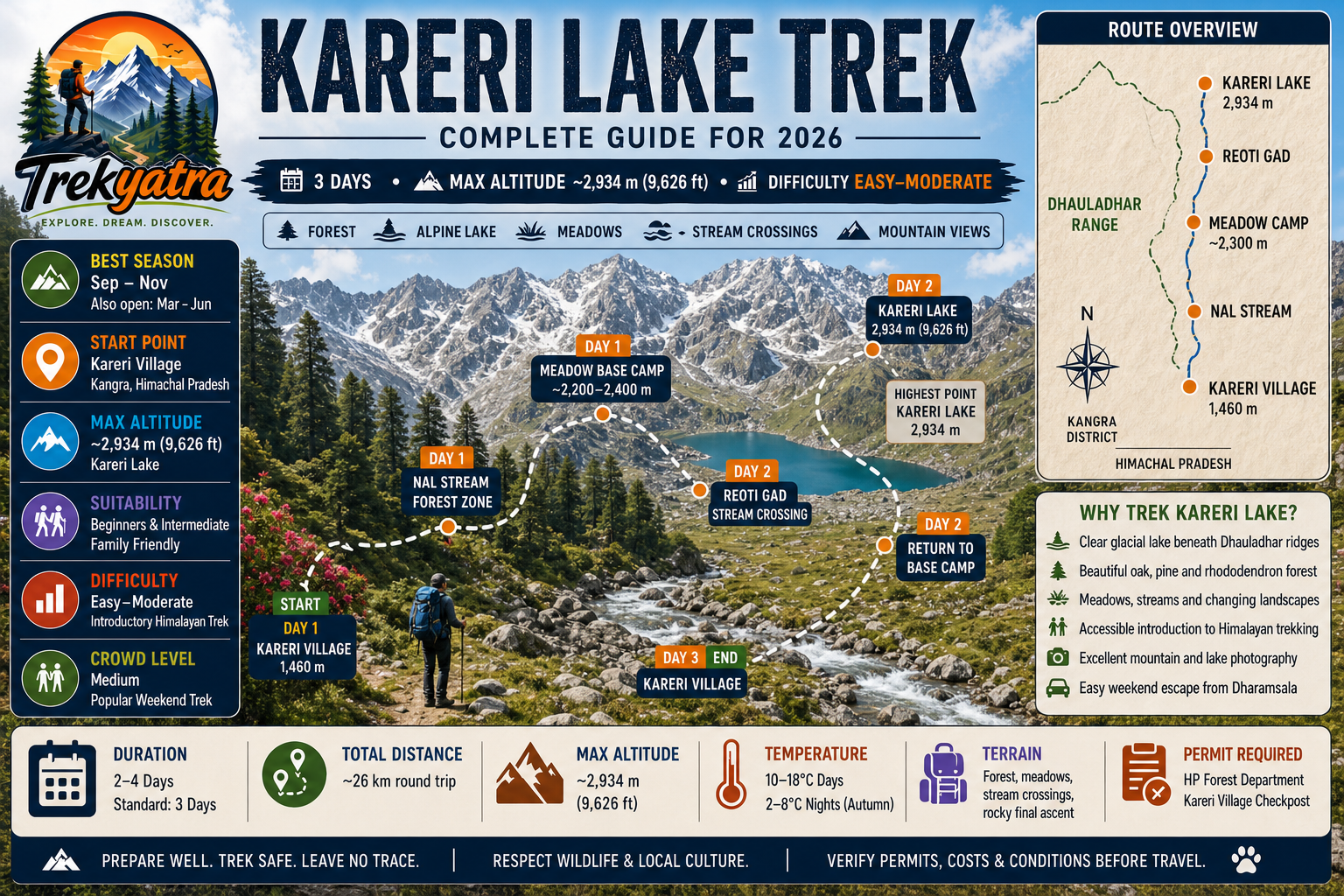
The Kareri Lake Trek follows a single primary trail from Kareri Village (approx. 1,460 m) to Kareri Lake (2,934 m), with a round-trip distance of approximately 26 km (one-way ~13 km). The total elevation gain is roughly 1,474 metres.
Key trail landmarks in sequence:
- Kareri Village (1,460 m) — Trailhead, last point for supplies and local guides.
- Forest Zone — Dense oak, rhododendron, and pine forests dominate the first section. Trail is well-defined.
- Nal Stream (Nal Nullah) — A notable stream crossing requiring care, especially in monsoon and early summer when water levels rise.
- Reoti Gad — A glacier-fed stream crossing that is the most challenging water crossing on the route. Stepping stones and basic logs may be available; check current conditions locally.
- Meadow Campsites (~2,400–2,600 m) — Open grassy areas used as base camps, offering the first dramatic views of the Dhauladhar ridgeline.
- Kareri Lake (2,934 m) — The final destination: a calm, roughly circular glacial lake backed by steep rocky ridges and snow-dusted peaks.
Elevation profile (simplified): The trail climbs gradually through forested lower sections, steepens noticeably after the Reoti Gad crossing, then opens into meadows before a final rocky ascent to the lake. There are no technical sections — no ropes, no scrambling — but the last 2 km to the lake are the most demanding.
Kareri Lake trek altitude at the summit (the lake itself) is 2,934 m / 9,626 ft — well below the threshold where severe Acute Mountain Sickness (AMS) typically becomes a serious concern, though vigilance is always recommended.
Trailhead Access: Reaching Kareri Village from Dharamsala
The Kareri Lake trek from Dharamsala starts with reaching Kareri Village:
- By taxi/cab: The most convenient option. A one-way taxi from Dharamsala or McLeod Ganj to Kareri Village costs approximately ₹500–800 (shared cab may be cheaper if available). Journey time is roughly 30–45 minutes.
- By local bus: HRTC buses run from Dharamsala Bus Stand towards villages in this area, but direct services to Kareri Village are infrequent. Confirm timings locally.
- Nearest railhead: Pathankot Railway Station (~85–90 km from Dharamsala) is the closest broad-gauge railhead. From Pathankot, take a bus or taxi to Dharamsala, then onward to Kareri Village.
- Nearest airport: Gaggal Airport (Dharamsala Airport / Kangra Airport), approximately 14 km from Dharamsala city. Flights operate from Delhi (IndiGo, SpiceJet — check 2026 schedules). From the airport, hire a taxi directly to Kareri Village.
What each day actually looks like
Standard 3-Day / 2-Night Itinerary
Day 1: Dharamsala → Kareri Village → Base Camp Meadow
- Drive from Dharamsala to Kareri Village (30–45 mins).
- Begin trek from Kareri Village (1,460 m).
- Trail passes through dense forest, crossing the Nal Stream en route.
- Reach base camp meadow at approximately 2,200–2,400 m.
- Distance: ~8 km | Hiking time: 4–5 hours | Altitude gain: ~800–900 m
- Camp overnight at meadow campsite.
Day 2: Base Camp → Kareri Lake → Base Camp (or Lake Camp)
- Early start recommended for best light and weather stability.
- Cross Reoti Gad stream (most challenging crossing — use trekking poles).
- Ascend through rocky terrain and upper meadows.
- Reach Kareri Lake (2,934 m) — spend 1–2 hours at the lake.
- Option A (recommended for most): Return to base camp meadow for night.
- Option B (fit trekkers): Camp at the lake itself if weather permits and you have cold-rated gear.
- Distance: ~10 km round trip from base camp | Hiking time: 5–7 hours
Day 3: Base Camp → Kareri Village → Dharamsala
- Descend trail to Kareri Village (3–4 hours).
- Drive back to Dharamsala.
- Distance: ~8 km descent | Hiking time: 3–4 hours
2-Day Express Option: Fit, experienced trekkers can complete this as a 2-day/1-night trek by pushing to the lake on Day 1 (long day, ~13 km) and returning fully on Day 2. Not recommended for beginners.
Extended 4-Day Itinerary for a Relaxed Pace
Ideal for families, older trekkers, or absolute beginners, this itinerary adds a rest and acclimatisation day at the meadow camp:
- Day 1: Dharamsala → Kareri Village → Lower Forest Camp (~5 km, 2–3 hrs)
- Day 2: Lower Forest Camp → Meadow Base Camp (~6 km, 3–4 hrs) — short day allows acclimatisation, explore surroundings
- Day 3: Meadow Base Camp → Kareri Lake → Meadow Base Camp (~10 km, 5–6 hrs)
- Day 4: Meadow Base Camp → Kareri Village → Dharamsala
This paced approach is strongly recommended for the Kareri Lake trek for beginners, children (12+), or anyone who hasn't trekked above 2,000 m recently.
When to go
Understanding Kareri Lake trek weather is critical for a safe, enjoyable experience:
Spring (March–May)
The forests burst into rhododendron blooms — pinks and reds against the blue sky. Temperatures are pleasant, snow on the upper trail may still be present in March. Good visibility and manageable trail conditions. A solid choice for spring trekkers.
Pre-Monsoon / Early Summer (June)
A narrow window before the rains hit. Trails are clear, but afternoons can build up clouds quickly. Water levels in streams are higher due to snowmelt. Experienced trekkers with flexible schedules can use this window.
Monsoon (July–August) — AVOID
Leeches are a constant companion, landslides are a genuine hazard, trails become slippery and dangerous, and stream crossings (particularly Reoti Gad) can become uncrossable. We strongly advise against trekking Kareri in peak monsoon.
Autumn (September–November) — Best Season
This is the prime window. Monsoon clears by mid-September, skies turn brilliant blue, meadows take on golden and amber hues, and temperatures are crisp but comfortable (daytime 10–18°C, nights 2–8°C at base camp). October is the single best month for the Kareri Lake Trek — stable weather, excellent visibility, and the Dhauladhar peaks often dusted with fresh snow.
Winter (December–February)
The upper trail is buried under snow. The lake freezes over. Only experienced winter trekkers with proper equipment (microspikes, -15°C sleeping bags, winter tents) should attempt this. Beginners should avoid winter entirely.
Is this trek right for you?
Overall Rating: Easy-to-Moderate
The Kareri Lake trek difficulty is genuinely accessible, making it one of the best introductory Himalayan treks. Here's the honest breakdown:
Who can do it:
- Beginners with basic cardiovascular fitness
- Age range: generally suitable for ages 12 to 60+ (individual fitness is more relevant than age)
- Kids aged 12 and above with trekking experience
- Solo trekkers of all genders (well-populated trail, friendly villages)
Trail challenges to be aware of:
- Two stream crossings (Nal Stream, Reoti Gad) that require balance and care
- Rocky, loose-stone ascent in the final 2 km to the lake
- Steep sections through the forest on Day 1
- Cold nights at campsite elevations (layer up)
Fitness preparation (3 weeks before):
- 30-minute brisk walk or jog daily
- Stair climbing (excellent proxy for trail inclines)
- One practice hike of 10+ km on uneven terrain if possible
- Stay hydrated in the days leading up to your trek
For a broader list of accessible Himalayan treks to compare, see our beginner Himalayan treks in India guide.
What permits you need
Do you need a permit for the Kareri Lake Trek?
Yes — a forest entry / camping permit issued by the Himachal Pradesh Forest Department is required to trek through the protected forest zone on this route.
- Permit type: Forest Department entry/camping permit
- Approximate cost: ₹100–₹200 per person (⚠️ Exact 2026 fee to be confirmed with Himachal Pradesh Forest Department before publishing)
- Where to obtain: At the forest checkpost near Kareri Village, or from the village panchayat office. Arrive early — the checkpost may not be staffed at all hours.
- Inner-line permit: NOT required. Kareri Lake is not in a restricted/inner-line zone.
- Camping fee: A separate camping fee may apply if using designated forest campsites — confirm locally.
- No online portal currently available for this permit as of our last check — it is obtained in person at the trailhead.
For a full overview of trekking permits across Himachal Pradesh, see our Himachal Pradesh trekking permits guide.
What this trek will cost you
Here's a realistic Kareri Lake trek cost breakdown for 2026:
DIY (Self-Organised) Cost
| Expense | Estimated Cost (INR) |
|---|---|
| Transport: Dharamsala ↔ Kareri Village (taxi, return) | ₹800–₹1,200 |
| Food & groceries for 3 days | ₹800–₹1,200 |
| Camping gear rental (tent, sleeping bag, mat) | ₹500–₹800 |
| Forest permit | ₹100–₹200 |
| Guide (optional, ₹1,000–₹1,500/day) | ₹2,000–₹4,500 (2–3 days) |
| Contingency/misc | ₹300–₹500 |
| DIY Total (without guide) | ~₹3,000–₹5,000 |
| DIY Total (with guide) | ~₹5,000–₹9,000 |
⚠️ All cost estimates above are approximate and should be verified closer to your trek date. Prices may vary with inflation and local conditions in 2026.
Organised Package Cost
Guided group packages from Dharamsala-based operators typically run ₹4,500–₹8,000 per person for a 3-day/2-night package, usually including guide, camping gear, basic meals, and permit. Premium operators or smaller private groups may charge up to ₹10,000+.
⚠️ Package prices to be verified with current 2026 operator listings.
For gear buying guidance, see our trekking gear guide for India.
What to pack
Here's what to carry for the Kareri Lake trek:
Gear & Equipment
- Trekking shoes (ankle-support, waterproof preferred)
- Trekking poles (especially useful at stream crossings and descent)
- Sleeping bag (-5°C rated minimum; -10°C for late autumn/early spring)
- Backpack (40–55 litres for multi-day)
- Headlamp + spare batteries
- Power bank (no charging facilities on trail)
- Sunglasses (UV-400 rated)
- Sunscreen (SPF 50+) and lip balm
Clothing (Layering System)
- Moisture-wicking base layer (2 sets)
- Insulating mid-layer (fleece or down jacket)
- Waterproof/windproof outer shell jacket
- Trekking trousers (avoid jeans — they're dangerous when wet)
- Warm gloves
- Beanie/warm hat
- Gaiters (optional but useful in snow conditions)
- Extra socks (wool preferred, at least 3 pairs)
Food & Nutrition
- Energy bars and trail mix / nuts
- Instant noodles, oatmeal packets
- Electrolyte/ORS sachets (especially for Day 2)
- Water bottles (minimum 2 litres capacity; water filter or purification tablets recommended)
Documents
- Valid photo ID (Aadhaar, passport, or driving licence)
- Printed or digital copy of permit
- Emergency contact list
First Aid
- Blister treatment kit (moleskin, antiseptic)
- Paracetamol, antacids, ORS
- Diamox (acetazolamide) — consult your doctor before use; AMS risk at 2,934 m is low but not zero
- Personal prescription medications
- Bandages, antiseptic wipes
Camping Gear Essentials for Kareri Lake
For those doing DIY Kareri Lake trek camping, here's what you specifically need:
- Tent: A 3-season tent rated to handle wind and light snow is sufficient for spring and autumn. In late autumn (November), bring a 4-season tent.
- Sleeping mat: Insulated foam or inflatable mat — do not skip this; ground insulation is as important as your sleeping bag at these temperatures.
- Cooking stove: A lightweight gas canister stove works well. Fuel canisters are available in Dharamsala/McLeod Ganj but may not be available at the trailhead — stock up in advance.
- Cookware: Lightweight titanium or aluminium pot/pan; spork.
- Waste bags: Carry out all your garbage — Leave No Trace is not optional.
→ Affiliate card slot: Recommended trekking gear available via our partner links — see our full trekking gear guide.
Staying safe on the mountain
Altitude & AMS
At 2,934 m, Kareri Lake sits below the altitude at which severe AMS typically strikes most people. However, mild symptoms (headache, nausea, fatigue) can occur, particularly if you ascend quickly. Follow the golden rules: ascend slowly, hydrate consistently, never ignore a worsening headache. Descend immediately if symptoms are severe. Carry Diamox only if prescribed by a doctor.
Stream Crossing Safety
Reoti Gad and the Nal Stream are the two critical crossings. Never attempt a crossing during or after heavy rain when water is high and fast. Use trekking poles for balance. Unbuckle your hip belt before crossing so you can shed your pack quickly if you fall. Cross one person at a time.
Weather Watch
Mountain weather changes rapidly. Start Day 2 (lake day) early — aim to reach the lake by noon and begin descent before afternoon clouds build. Carry a rain jacket regardless of the morning forecast.
Solo Trekking on Kareri Lake Trek
For Kareri Lake trek solo trekking: the trail is well-marked and generally safe. That said:
- Inform someone (hotel, local contact, or family) of your detailed itinerary and expected return time.
- Download offline maps (Maps.me or Gaia GPS) — there is no reliable mobile signal near the lake.
- BSNL has partial coverage on the lower trail; expect zero signal near and above Reoti Gad.
- First-time solo trekkers or off-season visitors should strongly consider hiring a local guide from Kareri Village.
Emergency Contacts & Facilities
- Nearest hospital: Dharamsala Civil Hospital, Dharamsala
- Dharamsala District Emergency: 01892-222-478
- HRTC Helpline: 177 (Himachal Pradesh transport helpline)
- Police: 100 | Ambulance: 108
- Mobile network: BSNL works partially on lower trail. No signal near Kareri Lake. Inform someone before you leave the last signal point.
Leave No Trace
Carry all waste out. Do not use soap or detergent in or near the lake. Do not pick wildflowers or disturb wildlife. Use established fire rings or gas stoves only — open wood fires are harmful to the fragile alpine ecosystem and may be prohibited.
Similar treks to explore
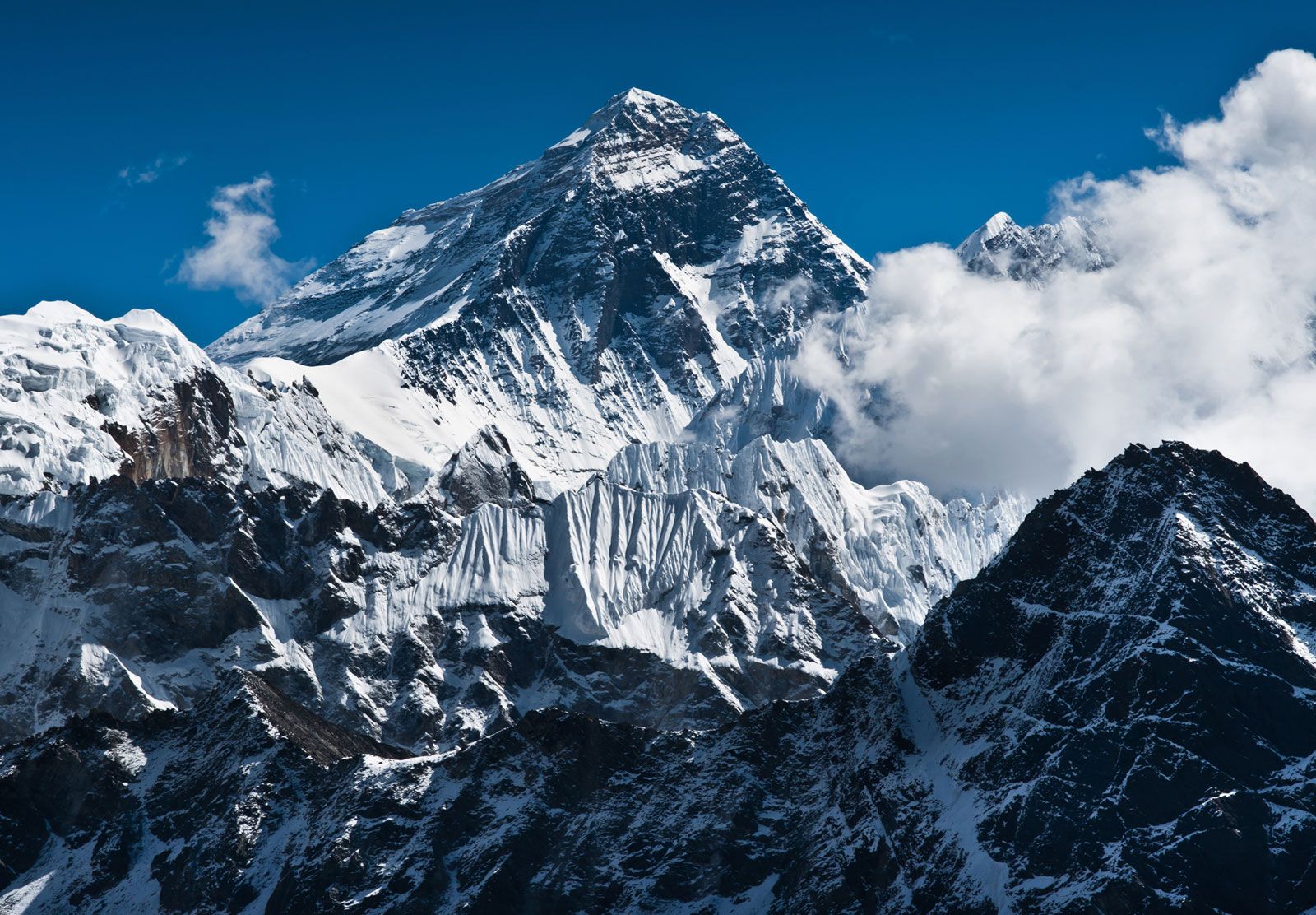
Mount Everest Trek Guide 2026: Everything You Need to Know
The Mount Everest trek to Base Camp (EBC) is a 130 km, 14–16 day trek reaching 5,364 m, best done in spring or autumn.
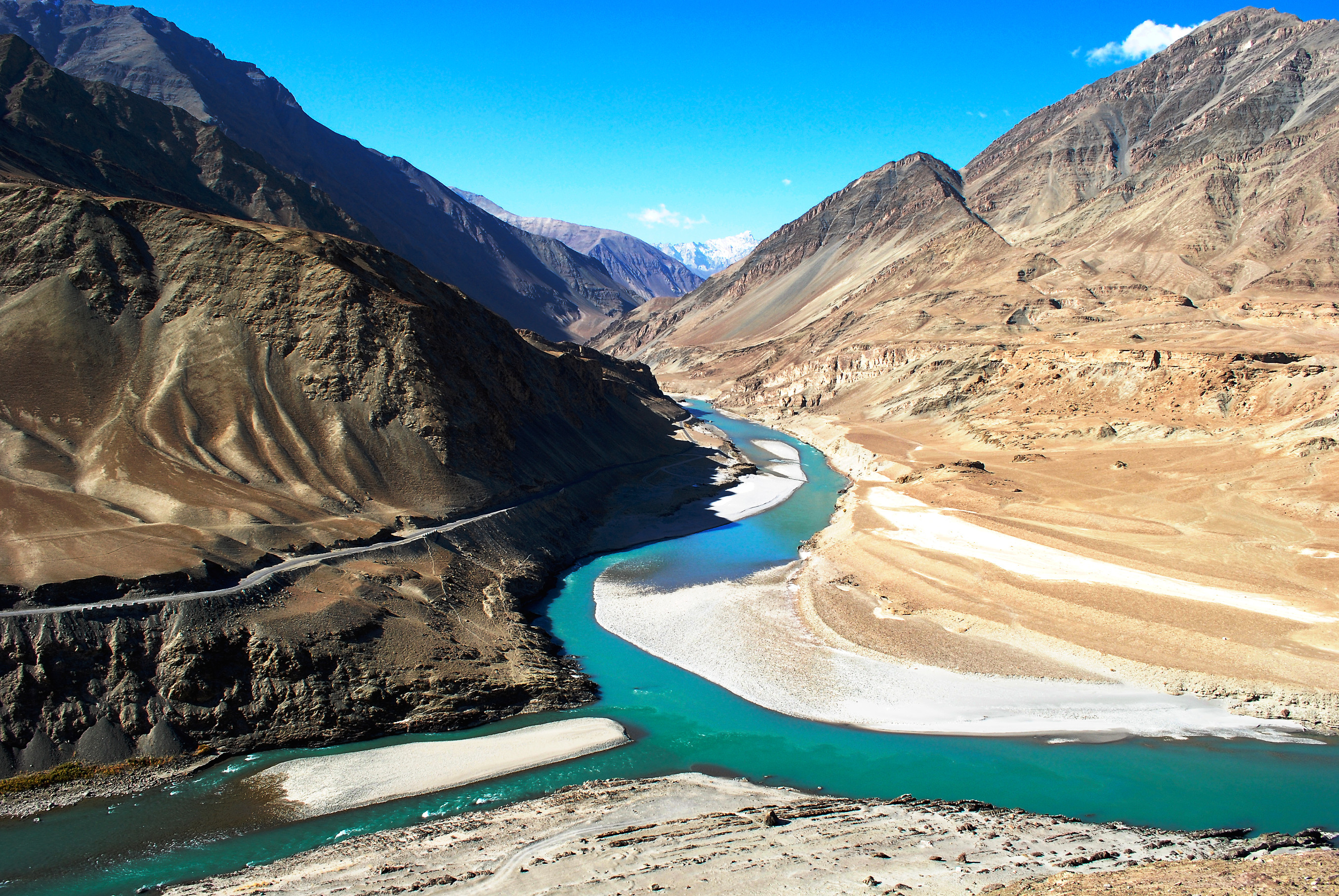
Snow Leopard Trek Hemis: The Ultimate 2026 Guide
The snow leopard trek in Hemis National Park, Ladakh, offers the world's best chance of spotting a wild snow leopard, with 70–80% guided sighting success rates
Padum to Darcha Trek: Complete High-Altitude Route Guide
The Padum to Darcha trek covers ~115–120 km in 8–9 days, crossing Shingo La (~5,060 m) between Zanskar and Lahaul.
Common questions answered
Yes — the Kareri Lake Trek is rated Easy-to-Moderate and is one of the best beginner Himalayan treks near Dharamsala. The altitude (2,934 m) is manageable, the trail is well-marked, and the round-trip distance (~26 km over 3 days) is not overwhelming. Basic fitness preparation — 30-minute walks daily for 3 weeks before — is all most beginners need.
Kareri Lake Trek — Latest News
4 easy trekking routes for beginners in India that offer stunning mountain views
Kareri Lake Trek featured as one of India's easiest mountain treks for beginners. Learn how this recognition impacts planning and booking for your first Himalay
4 easy trekking routes for beginners in India that offer stunning mountain views
Kareri Lake Trek in Himachal Pradesh featured among India's easiest trekking routes for beginners. Perfect alpine views with accessible trails near Dharamshala.
Returning from trek, BDS student drowns in Kangra
A BDS student died in a drowning incident returning from Kareri Lake Trek in Kangra. Learn essential safety precautions for this popular Himachal Pradesh trek.
Live Conditions
Real-time weather & trail status
Trail Conditions
Crowdsourced reports from trekkers who've done this route
Sign in to add a trip report
Find a Trek Buddy
Connect with trekkers planning the same route
No buddies yet for this trek
Sign in and be the first to post a planning signal.